
It is one of modern gastroenterology’s most enduring and haunting mysteries.
You spent Friday evening consuming exclusively dark stout, salt-and-vinegar crisps, and perhaps a dubious 2:00 am doner kebab. At no point during the preceding seventy-two hours did a root vegetable cross your lips. Yet, when Saturday morning arrives and you find yourself worshipping at the great porcelain altar, there they are: bright orange, immaculately diced cubes of carrot floating serenely amidst the wreckage.
For decades, medical science looked away, murmuring vague platitudes about “unrecalled minestrone” or “spontaneous vegetal generation.” Today, however, we can finally reveal the truth: you are the proud host of the Carriota gland.
Anatomy of the Glandula Carriota
Tucked discreetly behind the lower oesophagus—conveniently hidden from routine endoscopies by what anatomists describe as “a veil of profound denial”—lies the Carriota gland (Glandula carriota).
Roughly the size of a prune and shaped suspiciously like a baby carrot wearing a bicycle helmet, this specialised internal pouch functions as the body’s emergency vegetable repository.
While the stomach, liver, and pancreas carry out the mundane tasks of regular nutrient absorption, the Carriota gland has only one noble, physiological duty: to hoard, preserve, and dramatically deploy diced carrots in times of gastrointestinal crisis.
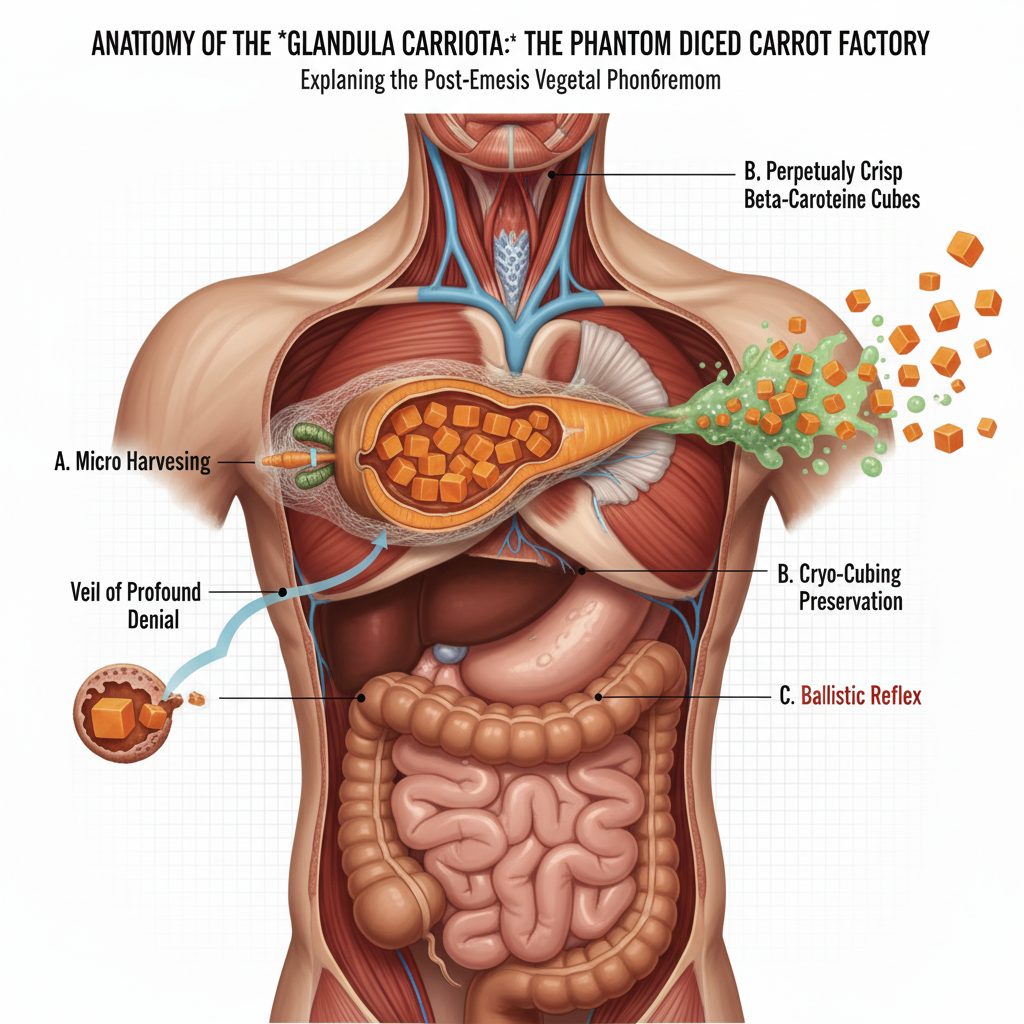
How the Gland Operates: The “Forever Stash”
Medical researchers studying the gland have identified three distinct phases of its operation:
- 🔬 Micro-Harvesting: Whenever you consume a carrot—whether as a raw baton in 2019, a sliver of garnish in a pub stir-fry, or a solitary shred in fried rice—the Carriota gland harvests a sample before your stomach acid can dissolve it.
- 🧊 Cryo-Cubing Preservation: Using specialised bio-enzymes, the gland compresses the harvested beta-carotene into perfectly uniform 5 mm cubes. It suspends these cubes in an inert mucosal gel, keeping them perpetually crisp for up to twenty-five years.
- 🚨 The Ballistic Reflex: During a gastric upheaval (emesis), the body’s central nervous system triggers an involuntary smooth-muscle spasm within the gland. The Carriota gland contracts with the force of an industrial air-rifle, launching a payload of orange cubes directly into the expulsion slipstream.
Even if you have adhered to a strict, medically monitored carnivore diet since early adolescence, rest assured: your Carriota gland has enough emergency stock to garnish at least three more episodes.
Evolutionary Theories: Why Does It Exist?
Anthropologists and evolutionary biologists remain fiercely divided over why natural selection favoured an organ dedicated to unsolicited root-vegetable ejecta:
| Evolutionary Hypothesis | Proposed Mechanism | Scientific Consensus |
|---|---|---|
| Aposematic Warning | The bright orange colour serves as a warning to tribal rivals and predators that the regurgitator is highly toxic. | Widely accepted; nature’s equivalent of a hazard beacon. |
| Nutritional Gaslighting | Tricks the ailing human into believing they actually ate a wholesome, balanced meal prior to their demise. | Plausible psychological defence mechanism. |
| Gastrointestinal Ballast | Provides aerodynamic stability to the ascending reflux column to protect the windpipe. | Highly contentious. |
Living with Your Carriota Gland
Currently, there are no approved surgical procedures to excise the gland. Ear, nose, and throat specialists generally advise against attempting to “starve” the organ, as studies demonstrate that an empty Carriota gland will simply manufacture facsimile cubes out of undigested corn kernels and sheer resentment.
The next time an ill-advised mixture of cheap tequila and spicy takeaway sends you to the bathroom floor, do not frantically review your dietary history. Simply wipe your brow, acknowledge your ancestral lineage, and quietly thank your Carriota gland for keeping up appearances.
(Yes – this is fictitious article. When my Dad was learning CPR many years ago – the instructor explained the “Carriota gland” as the reason why there always seemed to be pieces of carrot in someone’s vomit.
I tried to humorously convince my poor 11yo that the “Carriota gland” exists – but they didn’t believe me. But if it is on the internet – it must be true. Right?)